
Is the Landlord Responsible for Cleaning Windows?
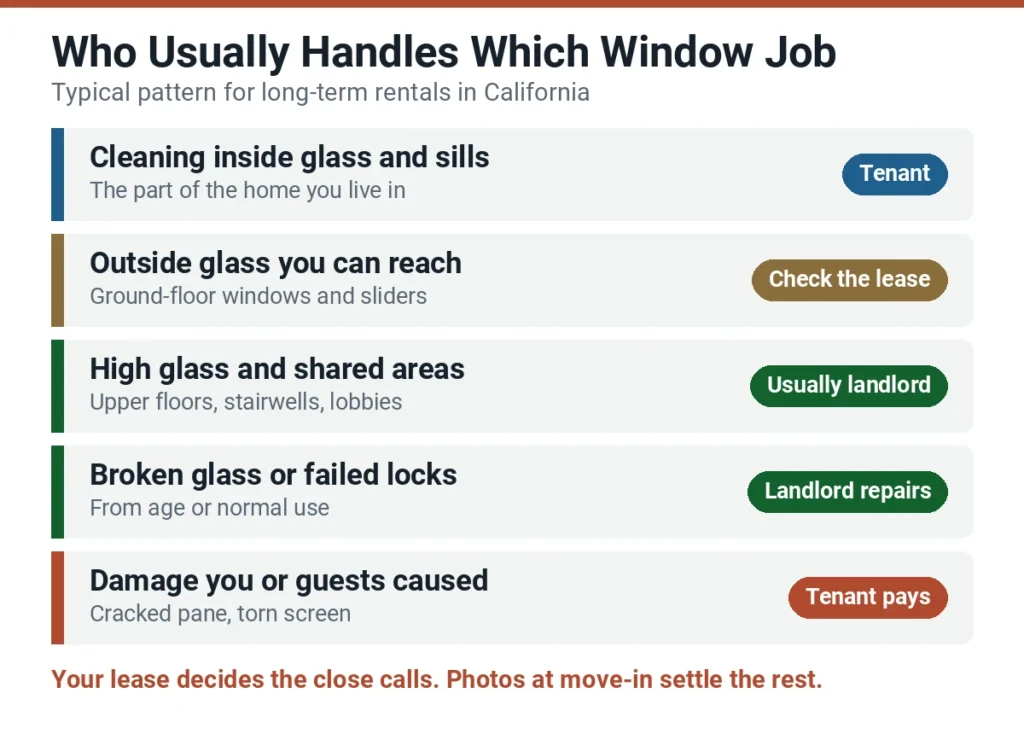
Is your landlord responsible for cleaning windows? Usually not the day-to-day cleaning. In a California rental, the tenant normally cleans the inside of the windows, while the landlord handles repairs, like broken glass or a lock that fails with age, and often any glass the tenant can’t safely reach. Your lease decides the close calls.
Here’s what California law says, where cleaning ends and repair begins, how windows affect your security deposit, and a simple move-in and move-out checklist that protects both sides.
What California Law Says
Three parts of the California Civil Code cover most window questions in a rental. This is general information, not legal advice.
- Section 1941.1, the landlord’s side. A rental must have effective weather protection, including unbroken windows and doors. That’s a repair duty, not a cleaning one.
- Section 1941.2, the tenant’s side. Tenants must keep the part of the home they occupy clean and sanitary, and must not damage it or let guests damage it.
- Section 1950.5, the deposit. A landlord can deduct for cleaning only to bring the unit back to the level of cleanliness it had at move-in, and can’t charge for normal wear and tear.
For the full picture, the state’s tenant guide from the California Department of Consumer Affairs is a good place to read more.
Cleaning vs. Repair: Where the Line Is
| Window issue | Usually | Why |
|---|---|---|
| Dirty inside glass, sills, blinds | Tenant | Part of keeping your home clean |
| Sand and dust in slider tracks | Tenant | Everyday cleaning |
| Upper-floor or shared glass | Landlord or building | Not safely reachable by tenants |
| Glass cracked from age, failed seal, worn-out lock | Landlord | Habitability and repair |
| Glass or screen damaged by tenant or guests | Tenant | Damage, not wear |
Many leases spell this out. If yours says the landlord handles outside window washing, or that the tenant does, that wording is what counts.
Windows and Your Security Deposit
Windows, screens and tracks often come up at move-out, because they’re easy to see and easy to photograph. The key rule is fairness both ways: the tenant returns the windows as clean as they were at move-in, and the landlord can’t charge to make them cleaner than that.
- You can ask for an inspection up to two weeks before you move out, so you have time to fix anything flagged
- The landlord has 21 days after you move out to return the deposit with an itemized list of any deductions
- Since 2025, California landlords must photograph the unit when a tenant moves out and after any cleaning or repairs, and for leases starting after July 1, 2025, before move-in too
- Fixed or automatic cleaning fees written into a lease are no longer allowed
If you’re moving out and want help with the glass, see the move-out section of pre-listing and move-out window cleaning.
The move-in and move-out window checklist
- Photograph every window inside and out, plus sliding doors, with the date
- Note any scratches, chips, fog between panes or stains already there
- Check every screen: present, torn, bent, and which window it belongs to
- Look at the tracks and sills for sand, dust and dead bugs
- Open, close and lock every window, and video it
- Check blinds for bent slats or missing parts
- Do the same walk-through, in the same order, when you leave
Matching move-in and move-out photos settle most window disputes before they start, for tenants and landlords alike.
Broken Glass, Screens and Locks
Report any broken window, failed lock or torn screen to your landlord in writing as soon as you notice it. A broken window affects security and weather protection, so it shouldn’t wait for move-out. If it wasn’t caused by you or a guest, the repair is normally the landlord’s job. Torn screens are often a quick fix. See window screen repair. Fog between double-pane glass is a failed seal, not dirt. See condensation between window panes.
San Clemente Rentals
Rentals near the beach get salt film on ocean-facing glass and sand in the slider tracks, often faster than inland homes. That makes move-in photos even more useful: haze or gritty tracks that were there on day one shouldn’t end up on the tenant’s bill. For tracks, see how to clean window tracks.
Vacation rentals work differently, since guests aren’t tenants. And if you own a condo in an HOA community, the question is between you and the association. See does your HOA clean your windows.
Landlord and Tenant Window FAQs
Moving in or out? Call (949) 203-0880. Tell us the move date and roughly how many windows the home has.