
Why Are My New Windows Scratched?
Why are my new windows scratched? Usually because something hard got dragged across the glass between the factory and move-in day: grit fused to tempered glass at the factory, tools set on sills, stucco or paint scraped off by other trades, or a dry blade during cleanup. Many scratches only show up after the first real clean, which is why they seem to appear out of nowhere.
Here’s where scratches on new windows come from, how to tell a scratch from leftover residue, what window makers count as a real defect, and what to do before your final walkthrough.
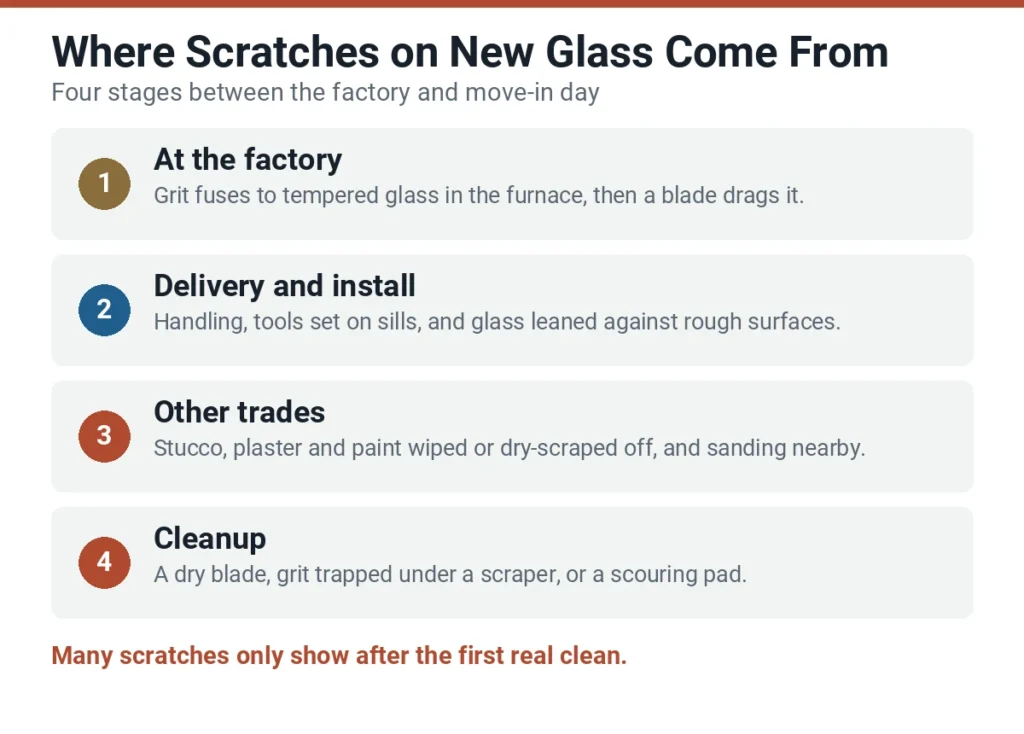
Where Scratches on New Glass Come From
- At the factory. Some tempered glass carries tiny particles that fused to it during heating. More on that below.
- Delivery and install. Glass gets leaned, carried and set down, and sills become a handy shelf for tools.
- Other trades. Stucco, plaster, mortar, paint and texture end up on the glass and get wiped or dry-scraped off. Nearby sanding sends grit flying.
- Cleanup. A dry blade, grit trapped under a scraper, or a scouring pad can all leave lines.
Dust and residue hide a lot. It’s common for scratches to be there for weeks before anyone sees them, then show up the first time the glass is properly cleaned.
Tempered Glass and Fabricating Debris
Tempered glass is safety glass. Building codes require it in places like doors, sidelights, low windows and windows near a tub or stairway. You can usually find a small etched stamp in one corner.
To make it, glass is heated and cooled quickly. If glass dust from cutting and edging is still on the surface when it goes into the furnace, those particles can fuse to it. The window trade calls this fabricating debris. It’s invisible, and it does nothing until something pushes it, like a blade. Then it breaks loose and drags across the pane, leaving fine scratches that often run side by side.
That’s why the same careful cleaning can leave one window perfect and scratch the next. The difference is in the glass, not always in the cleaner.
Razor Blades: Tool or Problem?
A clean, sharp blade held flat on wet glass is how paint and stucco usually come off without harm. The blade itself rarely scratches. What does damage is whatever gets caught under it.
- A dry blade on dusty glass drags grit with it
- An old or chipped blade can mark the surface
- Fused debris on tempered glass can scratch even with a careful stroke
- Scraping a large area at once means any problem spreads across the whole pane
Careful cleaners keep the glass wet, use a new blade, and test a small corner first, then look at it in low, angled light before going further. Low-E and other coated glass needs extra care. See how to clean Low-E glass.
Scratch, Residue or Etching? How to Tell
| What you see | Likely cause | Quick check |
|---|---|---|
| A mark that comes off with glass cleaner | Residue, film or a smudge | Gone after a wipe |
| A fine line your fingernail catches in | A scratch | Still there after cleaning |
| A raised speck or blob | Paint, stucco or caulk | You can feel it on top of the glass |
| White spots or haze that won’t wipe off | Mineral spots or etching | See hard water spots, below |
A flashlight held almost flat against the glass makes scratches and residue easy to see. If it’s spots rather than lines, see hard water stain removal.
Normal or a Defect? The Inspection Rule
No glass is perfect up close, so window makers use a standard way to judge it. Their published inspection guides follow industry standards, and the method is much the same from one maker to the next:
- Clean the glass on both sides
- Stand about 6 to 10 feet back, depending on the size of the pane
- Face the glass straight on
- Look in daylight, but not direct sun
- Look through the glass at the view, not at the glass itself, for a few seconds
If you can’t see a mark that way, it usually isn’t counted as a defect. If you can, measure it and note where it is. Each maker publishes its own limits on size and spacing, so ask your builder or window dealer for the guide that applies to your windows.
Before your final walkthrough
- Have the glass cleaned, inside and out
- Do the 6-to-10-foot check on every window in daylight
- Then check up close with a flashlight held flat to the glass
- Photograph anything you find, with the window or room in the shot
- Give your builder a written list and keep a copy
- Report glass defects to the window maker with photos, as their warranty asks
Most window warranties cover manufacturing defects, not damage from handling or construction, so the sooner a problem is written down, the better. This is general information, not legal advice.
How to Protect New Glass
- Keep factory film or a protective cover on the glass until messy work is finished
- Ask trades not to use sills or glass as a work surface
- Have stucco, paint and overspray removed by someone who cleans construction glass
- Never let anyone dry-scrape the windows
- Ask how tempered and coated glass will be handled before cleanup starts
When to Get Help
If your new or remodeled home is ready for its first clean, see post-construction window cleaning in San Clemente. That covers getting stucco, paint and stickers off the glass, and what to check before anyone touches it. If you find fog between the panes rather than marks on the surface, see condensation between window panes.
Scratches on New Windows: FAQs
New build or remodel almost done? Call (949) 203-0880. Tell us how many windows you have and what’s on the glass.