
How to Clean Skylights Safely, Inside and Out
To clean skylights safely, start from inside the room with a microfiber cloth on an extension pole, dust first, then wipe with mild soapy water and dry. Clean the outside only if you can reach it from a safe spot without stepping on the roof. And check what your skylight is made of first: glass and plastic domes need different care.
In San Clemente there’s an extra reason for caution. Many homes here have red clay tile roofs, and tile cracks easily underfoot. Here’s how to clean skylights yourself without risking the roof, or yourself.
What Kind of Skylight Do You Have?
The rules change completely depending on the type, so check before you clean.
| Type | How to tell | Clean with |
|---|---|---|
| Glass skylight | Flat glass, often in a metal or wood frame | Water first, then mild soap or a non-abrasive glass cleaner |
| Plastic or acrylic dome | A raised bubble shape, sometimes slightly yellowed | Water and mild dish soap only. No ammonia, glass cleaner or solvents |
| Tubular skylight | A small round diffuser in the ceiling | A soft cloth and water on the diffuser |
Cleaning Skylights From the Inside
This is the safest part of the job, and often the part that makes the biggest difference to the room.
- Protect the floor. Move furniture and lay a drop cloth under the skylight.
- Dust first. Run a dry microfiber cloth or duster on an extension pole over the glass and frame. Wetting dusty glass just smears it.
- Wipe gently. Dampen a microfiber cloth with water and a few drops of dish soap. Spray the cloth, not the ceiling, so drips don’t stain the drywall.
- Dry right away with a second clean cloth, finishing at the edges.
- Do the shaft. Wipe the walls of the light shaft too. A dusty shaft dims the room as much as dirty glass.
Some venting roof windows rotate or tilt so you can clean the outside pane from inside. Check your skylight’s manual before you try it.
Cleaning the Outside Without Getting on the Roof
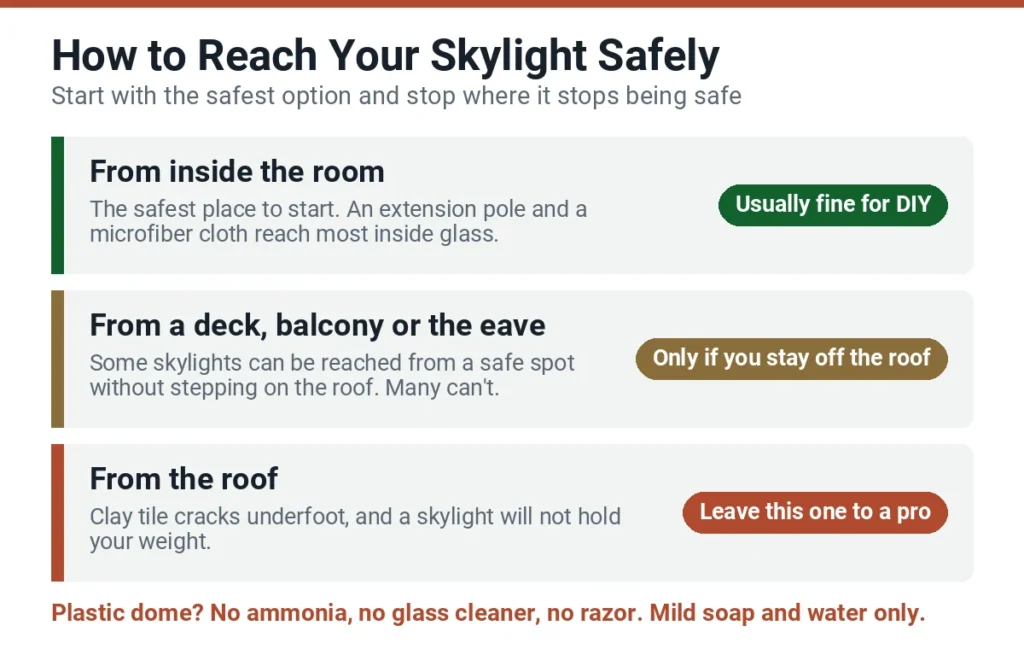
Skylight makers themselves recommend hiring a window cleaner for the outside, because getting onto a roof safely takes the right equipment. If you want to try, only clean what you can reach from a safe spot:
- A deck or balcony next to the skylight
- A second-story window that opens onto it
- A stable ladder at the eave of a single-story roof, with someone holding it, without stepping onto the roof
From there, rinse the glass first, wash with a soft cloth or sponge on a pole and mild soapy water, rinse again and dry. Be honest about the limits: most skylights lie back on a pitched roof, and many simply can’t be reached from the ground or the eave. Those are the ones to leave to a pro.
Stop here if
- You would have to step onto the roof
- The roof is clay tile, steep or two stories up
- You would need to lean on, kneel on or reach across the skylight
- You feel at all unsure on the ladder
Plastic and Acrylic Dome Rules
Plastic domes are easy to ruin. Skylight makers warn that ammonia, glass cleaners, alcohol, acetone and petroleum products attack the plastic, making it dry, brittle and cloudy, and that using them can void the warranty.
- Hose it off first. The dome shape rinses away a lot of dirt on its own.
- If it needs more, use mild dish soap and water and a soft cloth, with light pressure.
- Wipe in one direction, not in circles.
- Never use a razor, putty knife or abrasive pad on plastic.
- Don’t clean it in direct sun.
Clay Tile Roofs and Safety
Many San Clemente homes, from the older Spanish-style houses downtown to newer two-story homes inland, have red clay tile roofs. Tile cracks when it’s stepped on the wrong way, and a cracked tile on a slope is easy to slip on. A broken tile can also let water in during the next rain.
The other danger is the skylight itself. Most aren’t built to hold a person’s weight, and federal workplace safety officials have issued alerts about falls through skylights. Never lean on, kneel on or step near one. Ladders carry their own risk: more than 500,000 people a year in the U.S. are treated for ladder-related injuries, according to the CDC.
Mistakes that ruin skylights
- Walking on clay tile to reach the skylight
- Putting any weight on the skylight
- Ammonia or glass cleaner on a plastic dome
- Abrasive pads, or wiping a dusty dome dry
- Pressure washing
- Scraping large areas of glass with a razor
- Cleaning in hot, direct sun
When Cleaning Won’t Help
Some things look like dirt but don’t wash off: a yellowed or crazed plastic dome, scratches, or fog between two panes of glass. If your skylight still looks cloudy after a careful clean, see skylight and high window cleaning for what each problem means, and condensation between window panes for foggy glass.
When to Call a Pro
Call for help with any skylight you can’t reach without stepping onto the roof, skylights over stairwells or high ceilings, and plastic domes you’re not sure how to treat. See skylight cleaning in San Clemente, or call (949) 203-0880 for a free quote.
Skylight Cleaning FAQs
Can’t reach the outside of your skylight? Call (949) 203-0880. Tell us how many skylights you have and whether the roof is tile.