
Salt Film on Windows: Why It Comes Back and When It Etches the Glass
Salt film on windows is a thin, hazy layer of sea salt that settles on glass near the ocean. It’s carried in by the breeze, sticks in the damp morning air and dulls the view a little more every day. In San Clemente it’s the most common problem on any window that faces the water.
Most of the time it comes off easily. The trouble is that it keeps coming back, and if it’s left long enough it can do lasting damage. This guide covers what salt film is, how to tell it from hard water spots and etching, how to clean it safely and when it’s time to get help.
What Salt Film Actually Is
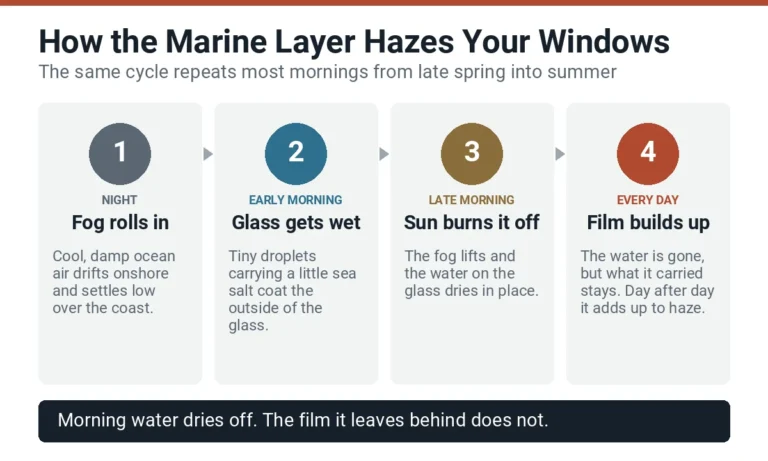
Ocean spray carries tiny droplets of seawater inland. When they land on glass and dry, the water leaves its salt behind, along with a little of the ocean’s other minerals. One day’s worth is invisible. A few weeks’ worth turns into the gray haze you notice when the sun is low.
It isn’t dirt, so a quick wipe with glass cleaner usually just smears it around. And it isn’t the same as the white spots sprinklers leave, which come from hard tap water rather than the ocean.
Why It Keeps Coming Back
Salt does something most dirt doesn’t: it pulls moisture out of the air. Once the humidity reaches about 75 percent, dry salt crystals start to turn damp again. On the coast that happens most mornings, so the film never fully dries out and blows away. It stays sticky and holds on to more salt each day.
The marine layer makes it worse. From late spring into summer, gray, damp mornings are the norm, and locals call the worst of it June Gloom. The onshore breeze comes mostly from the west and southwest, so glass facing that way gets the heaviest coat. Rain helps less than you’d think, because windows under eaves and balconies stay covered.
For a fuller look at salt, marine layer and Santa Ana dust, see why San Clemente windows get dirty so fast.
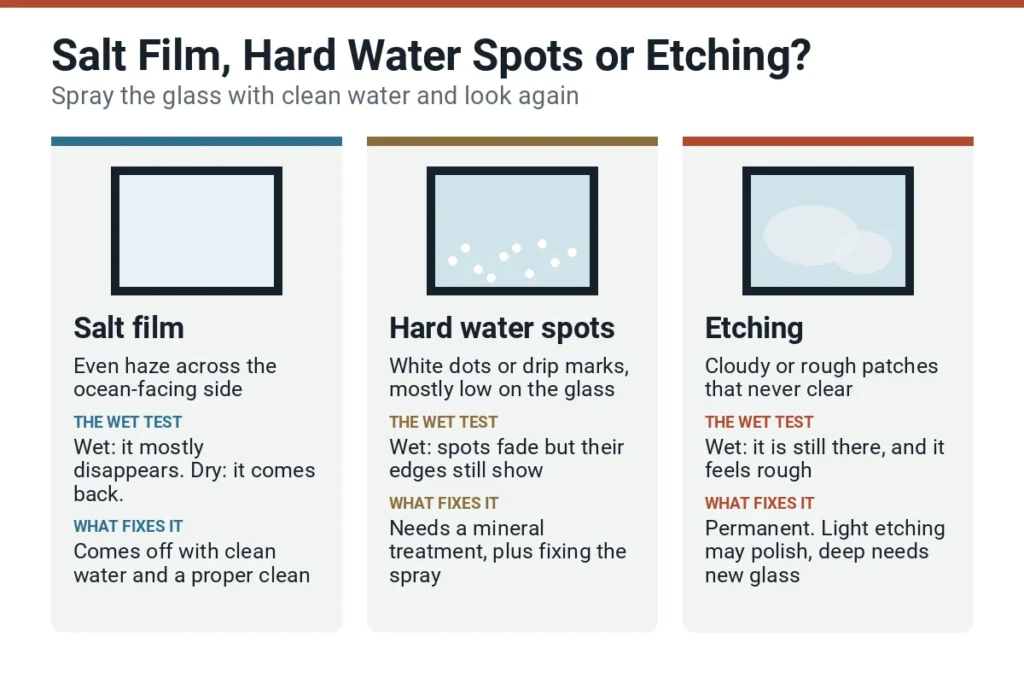
Salt Film, Hard Water Spots or Etching?
These three get mixed up all the time, and they need different fixes. On a lot of coastal homes you’ll find more than one on the same window.
| Salt film | Hard water spots | Etching | |
|---|---|---|---|
| What it looks like | Even haze across the glass | White dots, rings or drip lines | Cloudy or rough patches |
| Where it shows up | Ocean-facing glass, heaviest to the west | Lower glass near sprinklers or hoses | Where spots or film sat for a long time |
| When you wet it | Mostly disappears, then comes back dry | Fades, but the edges still show | Still there, and feels rough |
| What fixes it | Clean water and a proper clean | A mineral treatment, and moving the spray | Polishing if light, new glass if deep |
Two quick tests help. First, the wet test: spray the glass with clean water and look again. Then the light test: in a dark room, shine a flashlight across the glass at a low angle. Buildup looks like texture sitting on the surface. Etching looks like frost that’s part of the glass itself.
When Salt Film Turns Into Etching
Fresh film sits on top of the glass. Left for months, especially mixed with minerals from sprinklers or rain, it can start to eat into the surface. That’s etching, and it doesn’t wash off. Light etching can sometimes be polished down. Deep etching usually means the glass has to be replaced.
Signs the glass may be etched
- The haze is still there after a careful clean
- It doesn’t change when the glass is wet
- The glass feels rough where the haze is
- It has been building up for a year or more
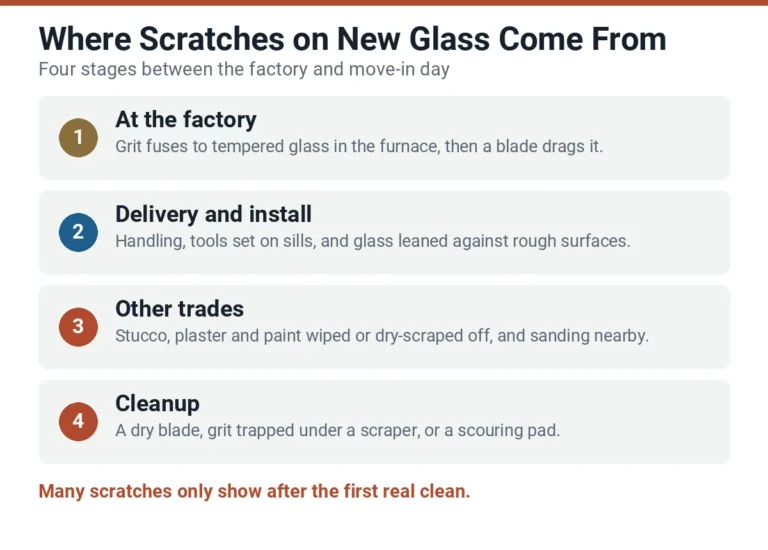
If that sounds like your windows, stop scrubbing. Harder scrubbing won’t fix etching and can scratch the glass. See hard water stain removal for what can and can’t come off.
How to Remove Salt Film Yourself
Salt dissolves in water, so the first step is simply lots of clean water. Work in the shade, so nothing dries on the glass halfway through.
- Wet the glass well before you touch it, so sand and salt crystals float off instead of scratching.
- Wash with a bucket of clean water and a few drops of dish soap, using a soft sponge or microfiber.
- If a haze is left once it dries, spray a mix of equal parts white vinegar and distilled water. Let it sit a few minutes, without letting it dry.
- Rinse with distilled water, not the hose.
- Squeegee from top to bottom, wiping the blade between passes, and dry the edges with a clean cloth.
What not to do
- Don’t wipe salty or sandy glass while it’s dry. It drags grit across the glass and leaves scratches that never come out.
- Don’t use a pressure washer. High pressure can push water past the seals.
- Skip steel wool, scouring pads and wire brushes.
- Don’t use razor blades on coated or tempered glass, which covers most sliding doors and newer windows.
- Don’t finish with a rinse from the hose. Tap water dries into new spots.
Where Salt Hits Hardest in San Clemente
Salt in the air drops off quickly as you move inland, so the homes closest to the water get by far the most. Bluff-top homes take the breeze head on, and glass facing west or southwest takes the worst of it.
- Pier Bowl, North Beach and T-Street
- Southwest San Clemente and Cyprus Shore
- Shorecliffs and Sea Pointe Estates
- The ocean side of Marblehead
- Capistrano Beach and the bluffs of Dana Point
Inland neighborhoods like Talega, Forster Ranch and Rancho San Clemente see much less salt. Their white spots usually come from irrigation instead. See sprinkler spots on windows.
How Often to Clean, and When to Call a Pro
Homes right on the sand or the bluff edge usually need their ocean-facing glass cleaned every 6 to 8 weeks. Homes a few streets back can often go every 2 to 3 months. See recurring window cleaning for a schedule by neighborhood.
Call for help if the haze doesn’t come off after a careful clean, if it looks etched, or if the glass is high or large. Big view windows and glass railings are hard to do without streaks. See ocean-view window cleaning, or call (949) 203-0880 for a free quote.
Salt Film FAQs
Is salt haze dulling your view? Call (949) 203-0880 for a free quote. Tell us which side of the house faces the water and how long the haze has been there.