Sprinkler Spots on Windows: Why They Keep Coming Back in San Clemente
Sprinkler spots on windows are white, chalky dots or drip lines on the lower part of the glass. They form when sprinkler water hits a window and dries in the sun, leaving its minerals behind. In San Clemente they’re one of the most common window problems, especially in inland neighborhoods with green slopes and timed irrigation.
The frustrating part is that they come back. You clean them, the glass looks fine for a few days, and then the spots return. This guide explains why that happens, how to tell sprinkler spots from other buildup, how to stop the spray and how to take light spots off safely yourself.
How to Tell Sprinkler Spots From Salt Film or Dirt
Not every white mark on a window comes from a sprinkler. Before you try to fix anything, it helps to know what you’re looking at.
| What you see | Where it shows up | Likely cause |
|---|---|---|
| White dots, rings or drip lines | Lower glass, often one side of the house | Sprinkler water drying on the glass |
| Even haze across the whole window | Ocean-facing glass near the coast | Salt film from the ocean air |
| Chalky streaks running down | Under stucco walls or new stucco | Calcium washing out of the stucco |
| Gray film that wipes off | Anywhere | Ordinary dust and dirt |
A quick test: if the marks wipe off with a damp cloth, it’s dirt. If they stay put and feel slightly rough, it’s mineral buildup. Spots that only appear on the lower half of the glass, on the side facing a lawn or slope, almost always come from a sprinkler.
Why San Clemente Water Leaves Such Stubborn Spots
Sprinkler spots are minerals, mostly calcium and magnesium, left behind when water evaporates. The harder the water, the more there is to leave behind. San Clemente’s latest water quality report, covering 2025, puts its imported water at about 14 grains of hardness per gallon on average, and water from the Baker treatment plant at about 17. Anything over about 7 grains per gallon counts as hard water.
Talega is a little different, because it gets its water from the Santa Margarita Water District rather than the city. The result on glass is similar, though: water that dries on a window leaves white spots.
The city also uses recycled water to irrigate golf courses, HOA greenbelts, medians and parks. If your windows face a greenbelt or a slope the HOA keeps watered, the spray hitting your glass may not even come from your own sprinklers.
Why the Spots Keep Coming Back
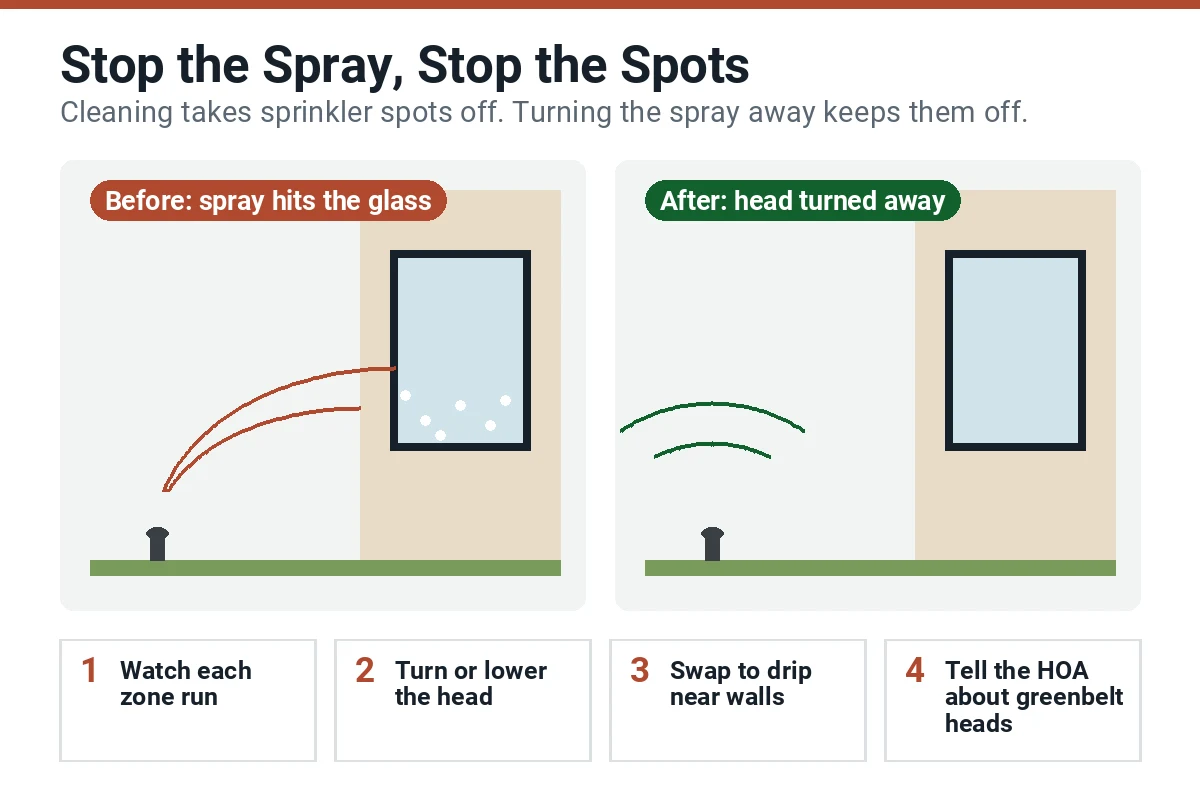
Cleaning takes the spots off, but it doesn’t change what caused them. If a sprinkler hits the same window every morning, each cycle adds a fresh layer of minerals. In the inland neighborhoods, where the sun often comes out while the coast is still gray, those drops dry fast and bake on.
That’s why the same window can look spotless after a clean and spotted again a week later. Until the spray stops, every clean is temporary. Most of the time the fix isn’t more cleaning. It’s moving the water.
Fresh Spots vs. Etched Glass
Fresh sprinkler spots sit on top of the glass and come off with the right cleaning. Spots left for months or years are different. The minerals slowly eat into the surface, and that’s called etching. Etched glass may only partly clear, even with professional treatment.
Signs the spots may have etched
- The spots are still visible after a careful clean
- The glass feels rough or pitted where the spots were
- The marks have been there for a year or more
- The window has a cloudy patch that never fully clears
If any of that sounds familiar, don’t scrub harder. Rough pads and blades can scratch the glass and make it worse. See hard water stain removal for what can and can’t be taken off.
How to Stop Sprinklers From Hitting Your Windows
This is the step that actually ends the problem. You don’t need to be an irrigation expert for most of it.
- Watch each zone run. Turn on one zone at a time from the controller and stand by the house. Note which heads reach the glass.
- Turn the head away from the house. Many spray and rotor heads can be adjusted for direction and arc, often with a small screwdriver or the key that came with them.
- Lower the spray. A smaller nozzle or a shorter throw keeps water on the plants instead of the windows.
- Switch to drip near the walls. Beds right against the house often do better on drip lines, which water the roots without spraying the glass.
- Check after any landscaping work. New plants, a new controller or a bumped head can change where the water goes.
If the spray comes from an HOA slope or greenbelt
Take a photo of the wet window and note the time the sprinklers run. Send it to your HOA or its landscaping company and ask them to adjust that head. It’s their equipment, and a small change usually fixes it.
How to Remove Light Sprinkler Spots Yourself
Fresh, light spots often come off with a simple vinegar solution. Work in the shade, so nothing dries on the glass before you rinse it.
- Rinse or wipe off loose dirt first, so you don’t rub grit across the glass.
- Mix equal parts white vinegar and distilled water in a spray bottle.
- Spray the spots and let it sit for a few minutes, without letting it dry.
- Wipe with a soft microfiber cloth.
- Rinse with distilled water, not the hose, and dry the glass with a clean squeegee or cloth.
What not to do
- Don’t use razor blades, steel wool or scouring pads. They can scratch the glass, and coated or tempered glass scratches easily.
- Keep vinegar off natural stone sills, and wipe metal frames dry afterward.
- Don’t rinse with the garden hose. Tap water leaves new spots as it dries.
When to Call a Pro
Call for help if the spots don’t move after a couple of careful tries, if they look etched, or if they’re on second-story or large view glass you can’t safely reach. Heavier mineral buildup needs a different treatment than a normal window clean, and the glass should be checked first. Read more about hard water stain removal, or call (949) 203-0880 for a free quote.
Once the spray is fixed, a regular clean keeps new spots from building up. Inland homes in Talega, Forster Ranch and Rancho San Clemente often do well every two to three months. See recurring window cleaning for a schedule.
Sprinkler Spots FAQs
Tired of the same spots coming back? Call (949) 203-0880 for a free quote. Tell us which windows get hit and how long the spots have been there.